
The Perfect Ambience Creates “Moments”
Beyond Décor: How to Design a Space People Actually Remember
Sight, sound, smell, touch, taste, and the one most people skip
Two rooms can have the same furniture, the same paint and the same budget, and people settle into one while the other empties out by nine. Two gatherings can have the same guest list, the same food and the same playlist, and only one of them gets brought up again months later.
The difference is almost never the décor, or the menu. It is everything those things are sitting inside: how the space sounds, what the air smells like, whether the seating lets people hear each other, whether the temperature is right, whether the light is doing anything at all.
We design for the eyes and then wonder why a beautiful room feels flat, or why a well-planned evening never quite lifted off.
The magic lies in creating an immersive experience that activates people’s innate senses.
It’s perhaps the most basic, yet often overlooked, aspect of creating a desired environment. Here is how to work with the rest of the senses, whether you are setting up a home or hosting a hundred people.
If you’d like to jump to any section:
1. Sight: the one everybody starts with

Sight gets the most attention, so this section is short. A few things that matter more than they get credit for.
- Light the walls, not just the floor. Light bouncing off a wall makes a room read taller and wider. A room lit only from the middle of the ceiling looks flat no matter what is in it. More on lighting here.
- Give the eye somewhere to rest. Empty space is not wasted space. It is what lets the good pieces read as good pieces. A room where every surface is occupied reads as noise, and the eye never settles.
- Colour sets the temperature of a room before anyone sits down. Warm shades bring energy and closeness. Cool shades bring calm and distance. Warm colours and where to use them, and cool colours and where they work best. There is also more on how colour affects you here.
- Add a view of something living. This one has real research behind it. In a well-known 1984 study, hospital patients recovering from surgery in rooms with a window facing trees went home sooner and needed less pain medication than patients facing a brick wall. Same surgery, same ward. A window seat, a plant in the sightline, a garden view. It is doing more than decorating.
By detecting and responding to physical stimuli, our sense of touch allows us to interact with our environment. Touch provides us with a unique way to experience the physical world, such as warm sunlight on the skin, physical contact with others, and even protection from harm.
Our skin, our largest organ, contains specialized sensory receptors that respond to touch, pressure, temperature, and pain. We use it to identify the shape and size of an object, feel the texture of a surface, and identify the temperature of a room.
2. Sound: the sense that decides whether people stay

Sound is the most underestimated element in any space, and the one guests notice last and feel first. A room that echoes makes people talk louder, get tired faster, and leave earlier. Nobody says “the acoustics were bad.” They say they were tired.
Fix the echo before you add anything
- Soft surfaces absorb sound. Hard surfaces bounce it. A thick rug with a dense pad underneath, lined curtains, upholstered furniture and a full bookshelf will noticeably calm a room.
- Getting fabric onto at least two surfaces makes the biggest difference. Floor and windows is the usual pairing, and it is often enough.
- Test it by clapping once in the middle of the empty room. If the sound rings on, you have work to do. If it stops flat, you are fine.
Music, and one correction worth knowing
You have probably heard of the Mozart effect, the idea that classical music makes people sharper. It has not held up. The original 1993 study found a small, temporary boost on one narrow spatial task, and most attempts to repeat it failed. The largest analysis, covering about 40 studies and 3,000 people, found the effect small at best.
Here is what researchers found instead, and it is much more useful. When they tested upbeat Schubert against Mozart, and even against a spoken story people enjoyed, they got the same result. What matters is mood and alertness, not the composer. Music people like puts them in a better state, and a better state is what produces the effect.
So the practical version:
- Play music your guests actually enjoy. That beats a “clever” playlist every time. Familiarity is a feature, not a failure of taste.
- Tempo sets the pace of the room. This one does have solid research behind it. Slower music keeps people at the table longer and slows movement through a space. Faster music moves people along. Restaurants and supermarkets have used this for decades.
- Keep it under conversation. If people have to raise their voices, the music is competing with the thing you invited them for.
Silence and steady sound both have a place
- White noise or a low steady hum masks unpredictable noise, which is usually far more distracting than constant noise. Useful in offices, bedrooms and anywhere with traffic outside.
- Deliberate quiet is a design choice, not an absence. Meditation rooms, galleries and reading corners all rely on it. Just make sure quiet does not mean echoey, or you get the worst of both.
Sound is how we navigate and engage with the world around us. Listening to sound allows us to recognize speech and language, connect with our surroundings, detect potential dangers, and derive pleasure from the sounds of nature, music, and musical instruments, among others. This process is how we perceive and experience the world. Thats why “noise pollution” must always be considered and adjusted.
Use sound to emphasize a space’s ‘theme’ or ‘function,’ tailoring it to its intended purpose.
3. Smell: the fastest route to a feeling

Have you ever entered a hotel lobby and been greeted by such an amazing scent that you couldn’t help but take a deep breath? Just the initial experience of your sense of smell being uplifted by this… can have a profound effect on the rest of your stay. This principle extends beyond hotels; your home, office, and other spaces, as well as various occasions, are no different.
Smell is the only sense wired almost directly into the parts of the brain handling emotion and memory. It skips most of the processing the other senses go through. That is why a scent can pull up a whole memory before you have identified what you are smelling.
It is also why hotels invest so heavily in a signature scent, and why a house smelling faintly of cooking feels lived-in in a way no styling can copy.
How to use it well
- Simple beats complex. This is the finding most people get wrong. In retail research, a single simple scent outperformed a more sophisticated blended one on actual sales. The theory is that a complex scent takes more mental effort to process, and that effort competes with everything else. So: one clear note, not a composition.
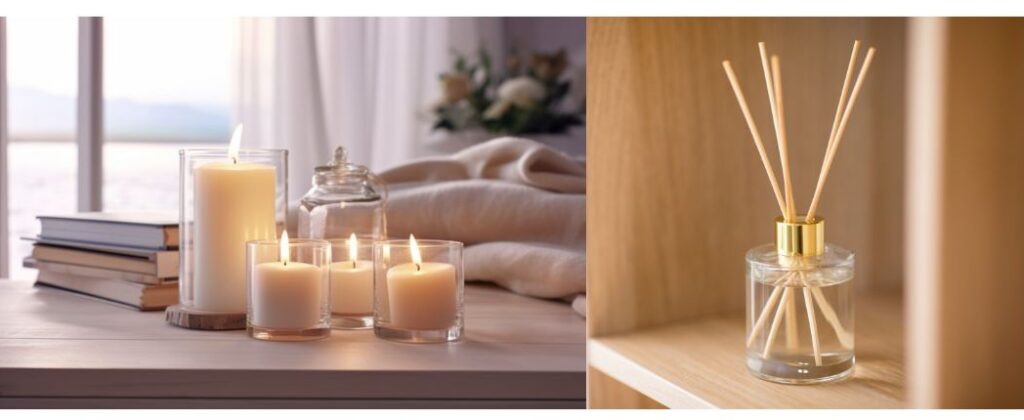
- Match the scent to the space’s job. Citrus and peppermint for energy, so kitchens, workspaces and gyms. Lavender, sandalwood and chamomile for rest, so bedrooms and quiet corners. Pine, cedar and eucalyptus for grounding.
- Keep it faint. The goal is that someone notices the room feels good, not that they can name the scent. If you can smell it clearly after five minutes in the room, it is too strong. You stop noticing your own home’s scent within minutes, so ask someone else.
- Use one scent family across connected rooms. Different scents in the entry, the living room and the kitchen fight each other. One family running through creates flow.
- Deal with bad smells before adding good ones. Scent layered over a musty room smells like a scented musty room. Ventilate, clean, then scent.
A note on what you are actually burning
We love candles and diffusers with pure essential oils. But it is worth knowing what you are putting into the air of a closed room.
- “Fragrance” on a label is a single word covering a long list of undisclosed ingredients, and phthalates are commonly among them. Worth reading up on synthetic fragrance before you commit to a plug-in habit.
- Anything burning also produces particulates, so ventilation matters even with a clean candle.
- The best-smelling room is often a well-ventilated one. Open a window for ten minutes. It resets a space more effectively than most products.
- Always give people an out. Some guests have migraines, asthma or fragrance sensitivity, and a heavily scented room can end their evening. Keep at least one area unscented.
4. Touch: comfort, and how seating changes a conversation

We are visual creatures, and our surroundings negate our perception. It is through the sense of sight that we can appreciate the beauty of our environment and make sense of the world around us.
Touch is doing quiet work the entire time someone is in your space. The cool of a glass table against the warmth of wood. Whether a cushion supports or swallows you. Whether the floor is soft underfoot.
Materials
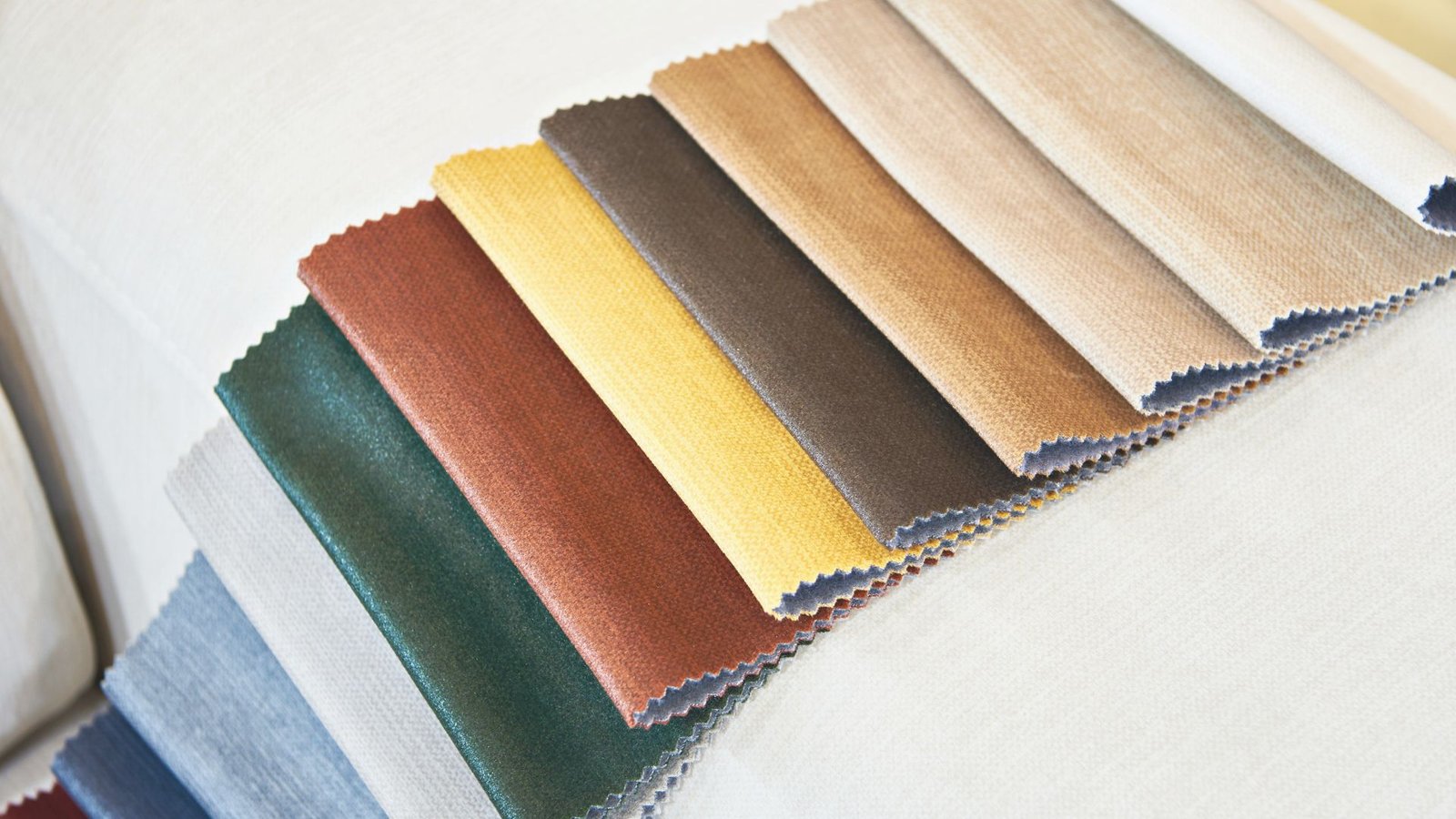
- Mix warm and cool textures on purpose. Wood, wool, linen and leather read as warm. Glass, stone, metal and polished concrete read as cool. A room of all one type feels either heavy or clinical, and the contrast is what makes both register.
- Put the soft things where people touch them. Armrests, throws, cushions, and the floor beside the bed. Anything you can save for the surfaces nobody makes contact with, save.
- Firm seating beats deep seating for a gathering. Deep sofas are lovely for a film alone. They are hard to get out of, they make conversation across a room awkward, and they make older guests avoid a seat entirely.
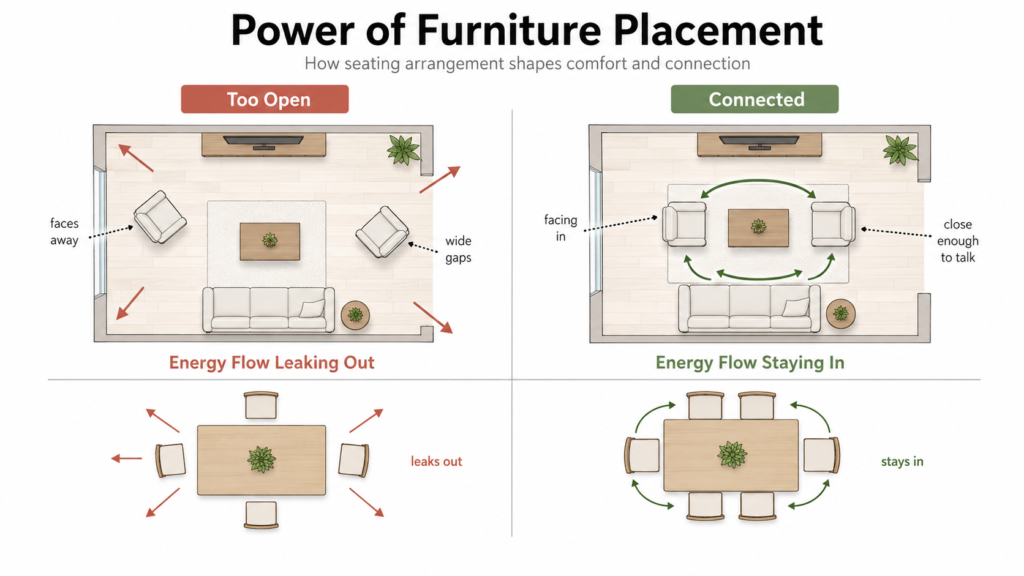
Seating layout, which matters more than most people realise
There is a term for this in environmental psychology. Seating that faces inward and encourages conversation is called sociopetal. Seating in rows facing the same direction, like an airport gate, is sociofugal, and it discourages interaction by design.
Most living rooms are accidentally sociofugal because everything points at the television.
- Aim for chairs to face each other at an angle, not straight on. Directly facing can feel confrontational. Something around 90 degrees is comfortable.
- Keep conversational seats within about four to eight feet of each other. Beyond roughly eight feet, people stop talking across the gap and the group splits. This is the single most common reason a big beautiful room feels awkward.
- Do not push all the furniture against the walls. It is the instinct in a small room, and it makes the room feel emptier and the conversation harder. Pulling seating in creates a defined zone with space around it.
- Break a large room into two clusters rather than making one enormous circle. Two groups of four talk. One group of eight fragments anyway, just less comfortably.
Think of energy in a room like water. You want it to gather and circulate, not run out through the gaps.
6. Taste: the part people remember longest
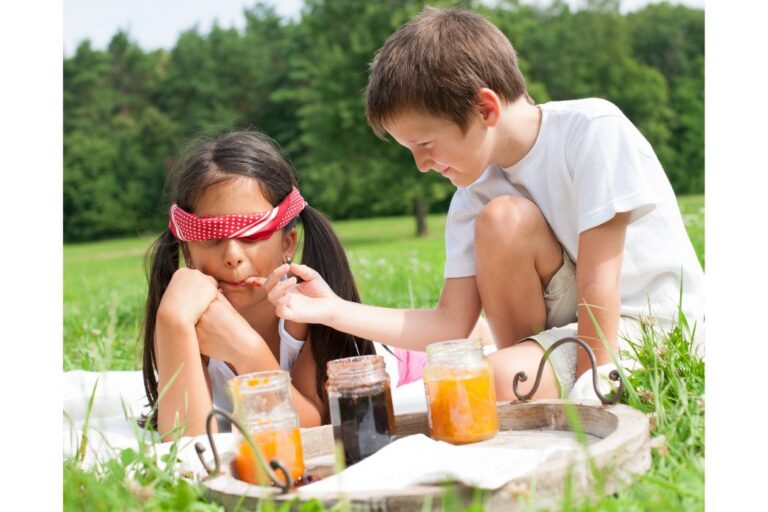
Guests forget the centrepiece. They remember the food.
- Feed people something, even at a non-food event. It signals care, it prevents the mood dropping as everyone gets hungry, and it gives people a reason to move around and talk.
- Give food and drink their own place in the room, away from seating. A food station creates natural movement and mixing. Food on a coffee table keeps everyone stuck in one spot.
- Match the food to the atmosphere you set. Warm drinks and a warm room. Something cold and bright for summer. This sounds obvious and gets missed constantly.
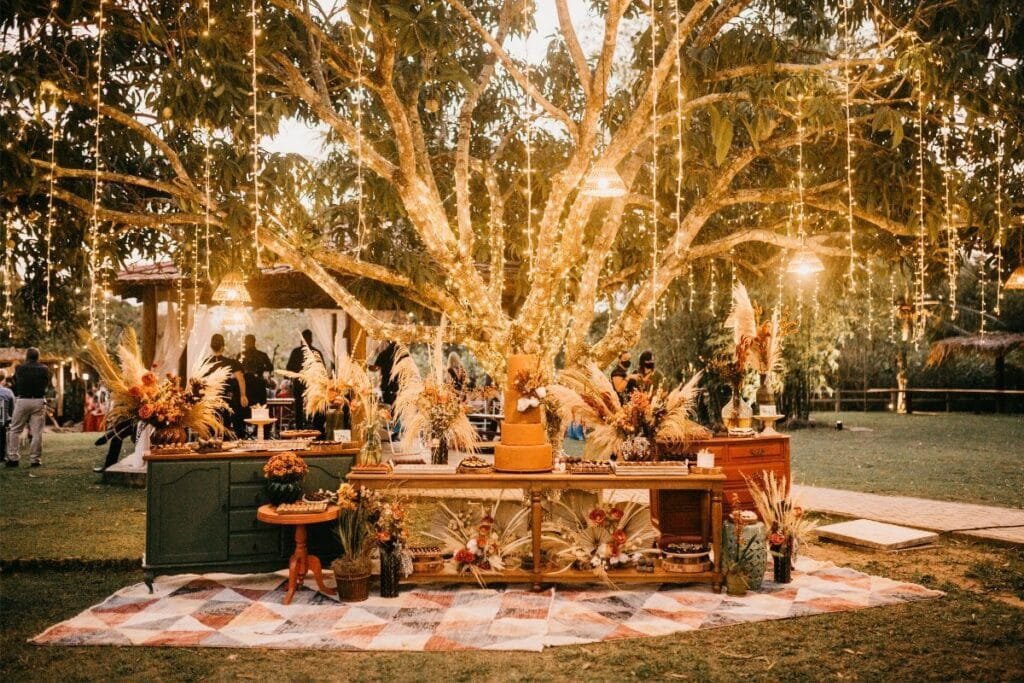
- Presentation is doing real work. The same food on a good platter reads as an occasion. Serving pieces, cloth napkins and a decent board cost little and get reused forever.
- One familiar thing. A dish someone recognises, or something homemade, lands differently than an entirely unfamiliar menu. Familiarity is what makes a memory attach.
7. Intuition: the read-through at the end

The sixth sense is sometimes called a “psychic” sense because it extends beyond sight, hearing, touch, taste, and smell. This extrasensory perception can be described as “feeling” or “intuition,” and provides us with information in ways not explained by the five physical senses.
We all possess the sixth sense, but if it is not exercised or utilized, it can become dormant or even lost. There are many ways to make use of the sixth sense.

Call it intuition, taste, or just experience. What it really is, is your brain noticing things you have not consciously named yet. And it is usually right.
The way to use it is simple. Before anyone arrives, sit down in the space and be a guest in it.
- Walk in through the front door as though you have never been there. What do you notice first? Is it what you want people to notice?
- Sit in every seat. Is there glare? Can you hear the person opposite you? Is there a light in your eyes? Is the chair facing a blank wall?
- Listen for a full minute with everything running. Music on, fridge going, extractor fan, air conditioning. That is the sound your guests will actually be sitting in, and it is almost never what you imagined.
- Ask what feels off. You will usually know. The answer is often a lamp, a chair angle, or a fan you have stopped hearing.
Then think about who is coming. A room for young colleagues wants open sightlines and furniture that moves. A room for a long dinner wants a fixed layout and lower light. A room for a family wants surfaces that survive things. Design for the people, not the photograph.
Where to start
Free, do it tonight
- Clap once in the empty room and listen for echo
- Sit in every seat and check for glare, distance and blank walls
- Pull the seating in off the walls
- Open the windows for ten minutes before guests arrive
- Set the temperature a couple of degrees cooler than feels right
Small budget, big change
- A thick rug with a dense pad underneath
- Lined curtains
- Two lamps instead of one ceiling light
- One simple scent, kept faint
- Serving pieces worth reusing
A proper plan
- Layered lighting on dimmers in every room
- Seating arranged in clusters within talking distance
- Soft surfaces on floor, windows and at least one wall
- A view of something living from wherever people sit longest
FUN FACTS
How Scents Affect Consumer Behavior
The use of scents by businesses to influence consumer behavior is fascinating. The following examples illustrate how scent influences consumer behavior:
- Movie theaters use popcorn aromas to create a welcoming and familiar atmosphere.
- The aroma of freshly brewed coffee in cafes and coffee shops stimulates the senses and invites consumers to come, stay, enjoy, and return for more.
- Cinnamon or vanilla are used at open houses to create a warm, welcoming environment, which could increase sales.
- Casinos use peppermint and citrus fragrances to create a positive and exciting atmosphere to encourage guests to play.
- Often, luxury hotels use scents like jasmine or sandalwood in their lobbies and common areas to convey an atmosphere of elegance and relaxation.
- Dealerships may diffuse scents like leather or new car smell to create an enticing atmosphere that associates their vehicles with freshness and desirability. This affects buyers’ purchase decisions.
- Some gyms and fitness centers use energizing scents like citrus or eucalyptus to invigorate visitors, improving their workout experience and motivating them to return.
Point Of Alignment
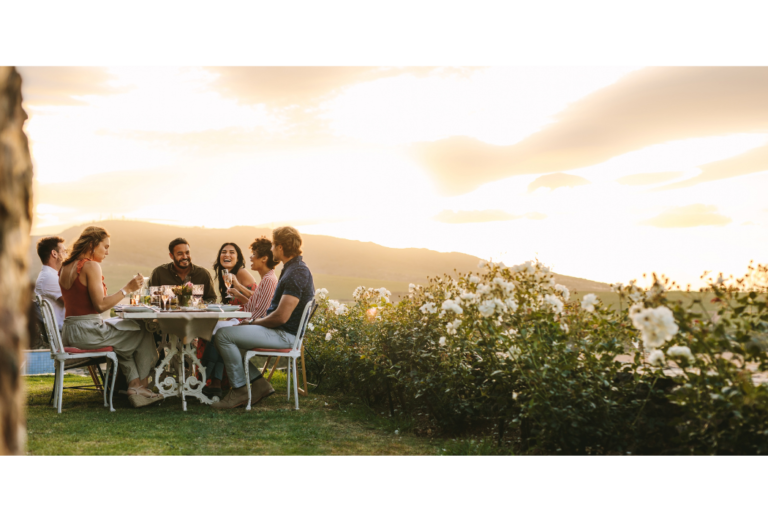
When people enjoy an event you’ve thoughtfully organized or appreciate a well-designed space you’ve created, it’s the most rewarding feeling. Create lasting impressions with these simple yet impactful steps for a multisensory experience!